Digital Investment Advisor (DIA) vs traditional investment advisor in Malaysia: Key differences and what you need to know
In Malaysia, a Digital Investment Adviser (DIA) and a Traditional Investment Adviser (IA) are both regulated by the Securities Commission Malaysia (SC), but they differ significantly in how advice is delivered, the underlying technology, client experience, and regulatory expectations.
Here’s what investors and financial institutions should know.
1. Regulatory differences
Malaysia became one of the first countries in ASEAN to establish a dedicated framework for Digital Investment Advisers (DIA).
A Digital Investment Adviser (DIA) in Malaysia must:
-
- Hold a Digital Investment Adviser (DIA) licence from the Securities Commission Malaysia.
- Has the capacity and capability in formulation and implementation of effective algorithm tools in its undertaking of proposed DIA activities including understanding of the rationale, risks and rules;
- Demonstrate robust governance over its algorithms.
- Validate and monitor algorithm performance.
- Ensure human oversight over the technology.
- Maintain risk management and cybersecurity controls.
A traditional Investment Adviser, on the other hand, relies primarily on qualified licensed representatives who assess clients and provide recommendations based on professional judgement.
2. How recommendations are generated
Traditional adviser
Recommendations usually will take into the following considerations:
- Company fundamentals
- Economic outlook
- Industry analysis
- Analyst research report
- Meetings with management
- Client objectives
- Adviser experience
Human judgement plays a significant role.
Digital Investment Advisor
Recommendations are generated using predefined rules and models such as:
- Patented formulas
- Quantitative screening
- AI or machine learning
- Statistical models
- Technical indicators
- Risk optimisation
- Portfolio algorithms
Digital Investment advisor is confined to the activities for automation of provision of Investment Advisor utilising algorithm-based tool without human adviser interaction in the advisory process.
3. Transparency
Traditional advice can sometimes rely on professional judgement that is difficult to quantify.
Digital Investment advisers generally require:
- Algorithm validation
- Ongoing performance monitoring
- Clearly defined and repeatable rules
- Appropriate historical datasets
- Out-of-sample or forward testing
- Ongoing monitoring of live selections
- Transparent reporting of both successful and unsuccessful signals
- Risk controls and suitability assessment
- Periodic review of the algorithm
This makes recommendations more reproducible and easier to review from a governance perspective.
4. Speed and scalability
A traditional adviser might serve hundreds of clients.
A digital investment advisor like SMARTRobie® mobile application platform can potentially serve tens of thousands of users simultaneously while applying the same methodology consistently.
This is one of the main advantages of the Digital Investment Advisory model.
5. Risks
Traditional adviser risks
- Human bias
- Inconsistent recommendations
- Key-person dependency
- Emotional decision-making
Digital adviser risks
- Model risk
- Algorithm errors
- Poor data quality
- Technology failures
- Cybersecurity threats
- Market regime changes that reduce model effectiveness
Neither approach eliminates investment risk.
6. Which is better?
The answer depends on the investor.
DIA and traditional advice can serve different needs
A traditional adviser may be more suitable when an investor needs comprehensive financial planning involving retirement, insurance, tax considerations, estate planning and family wealth.
A Digital Investment Adviser is designed for investors who want:
- Systematic and data-driven stock ideas
- Consistent screening rules
- Reduced dependence on emotion and market narratives
- Wider and faster market coverage
- Historical validation of earlier selections
- A measurable framework for evaluating investment signals
The two models do not need to be mutually exclusive. An investor may use traditional wealth planning to establish overall financial goals and asset allocation, while using an algorithm-driven DIA to support the stock-selection component of the portfolio.
Increasingly, many companies are adopting a hybrid model, combining algorithmic recommendations with human oversight and support.
Key takeaway
The core distinction is:
- Traditional Investment Adviser: Human expertise is the primary engine of investment advice, with technology serving as a supporting tool.
- Digital Investment Adviser: Technology and algorithms are the primary engine of investment advice, with humans responsible for governance, oversight, compliance, and client support.
For institutional clients, banks, brokers, and wealth managers, the key question is often not whether digital advice will replace human advisers, but how both can be combined to deliver scalable, consistent, and compliant investment services.
How can companies collaborate with TradeVSA?
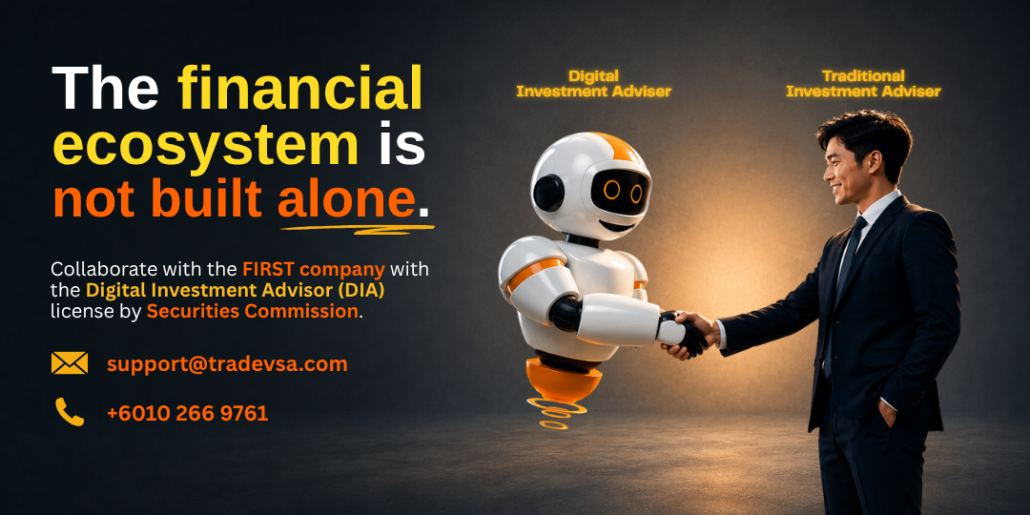
TradeVSA System Sdn Bhd is the first company being granted the Digital Investment Advisor (DIA) license by Securities Commission on 25 September 2024.
TradeVSA is open to partnerships because we do not believe one company should build the entire financial ecosystem alone.
TradeVSA’s strength is investment research, quantitative strategies and our Pentagon Guider® technology. However, a complete investment journey also requires brokerage execution, data, compliance, customer education, distribution and portfolio reporting.
We generally look at collaboration in two areas.
On the technology side, we are interested in partners involved in:
- Market and alternative data
- AI research and model validation
- Brokerage and order-management connectivity
- Fraud, cybersecurity and identity protection
- Portfolio analytics and investor reporting
- Explainable AI and regulatory technology
On the go-to-market side, we can work with:
- Brokers
- Banks and asset managers
- Digital investment platforms
- Financial advisers
- Universities and investor-education providers
- Fintech companies expanding across ASEAN
Reach out to us at support@tradevsa.com or +6010 266 9761.